How to use a mortgage to consolidate debt
Table of contents
It’s so easy to run up unsecured debt: car loans, store cards, credit cards, overdrafts. The list goes on.
You can consolidate that debt with a remortgage or a secured loan.
We run through your options here:
- What types of unsecured debt you can consolidate
- What types of unsecured debt lenders won’t let you consolidate
- The pros and cons of remortgaging to consolidate debt
- Circumstances where a secured loan (second charge mortgage) may serve you better
- Why you should ALWAYS get a copy of your credit report
Using a remortgage to consolidate outstanding debt
Debt! I can all but guarantee that everyone visiting this guide has some. And, let’s face it: debt can get messy. You make different payments from your account on different days of the month. All manner of interest rates eat into your remaining disposable income. And, if there are problems, you have to contact multiple respective creditors.
Wouldn’t it be great if you could just:
- Consolidate that debt into one payment
- Have the payment go out on one day of the month
- Pay one lower interest rate, freeing up more of that elusive disposable income?
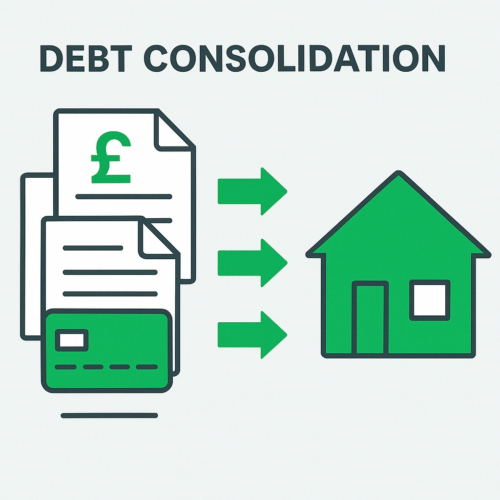
With a debt consolidation mortgage, you could do just that. Using the equity in your home, you can bundle all or some of that debt into one manageable payment.
What types of debt can you pay off with a debt consolidation mortgage?
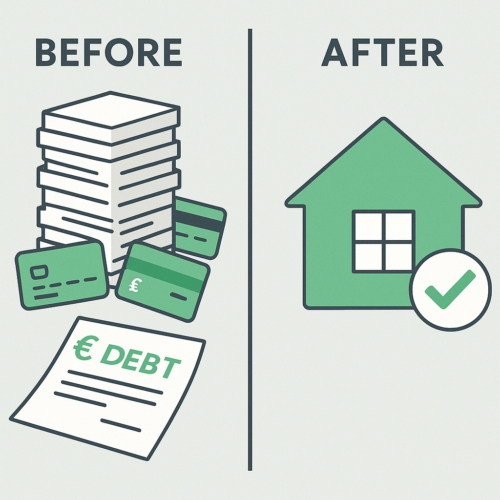
A debt consolidation mortgage combines multiple debts into a single loan. On the upside, this will clear any debt that you use the remortgage to pay off. On the downside, your outstanding mortgage balance will increase.
You can use a debt consolidation mortgage to pay off most types of unsecured debt. However, not all types of debt are eligible for this type of finance. It’s our job to determine if your debt qualifies, and if the positives outweigh the negatives.
Common debt types for consolidation
Lenders allow homeowners to consolidate a broad spectrum of debt through a remortgage. One reason they’re keen is that they’re rarely the creditor tied to the debt outside your mortgage.
For them, anything debt-consolidated is credit that they would not otherwise earn interest from. Here are some examples of what they will allow you to consolidate:
Credit and store cards:
High-interest credit card debt can be one of the most crippling and enduring types of debt. Consolidating that debt is a key reason people remortgage. That’s because remortgaging often offers a lower overall interest rate and a definite end date
Personal loans:
People take out personal loans for many reasons. It’s become so easy that you can even apply for a loan through your online banking app. It’s also not unusual for homeowners to have concurrent outstanding loans.
Lenders will generally accommodate multiple personal loans as a reason to remortgage. But some may be reticent to allow personal loans or hire purchase agreements with less than 12 months remaining.
Car loans:
Today, you can hardly buy a car for less than a 5-figure sum. That debt is exacerbated when households own more than one vehicle. Homeowners can use a remortgage to consolidate car loans or hire purchase agreements.
Overdrafts:
If not managed correctly, people can easily come to think of an overdraft as an extension of their monthly income. Lenders will allow homeowners to consolidate their overdrafts in a debt consolidation mortgage.
However, to get the most out of this facility, the borrower must demonstrate willpower. With the debt consolidated, they should see a reduction in their monthly outgoings. As such, it is in the borrower’s best interest to minimise their overdraft usage going forward.
Student loans:
Student loans can be a real burden for newly qualified graduates. This is especially pertinent to younger homeowners considering starting a family. Ridding that millstone can free up much-needed income. Some (but not all) lenders allow student loans to be paid off through debt consolidation.
Existing secured debt:
Many homeowners take out a secured loan (second charge mortgage) when making home improvements or buying a car. It’s rare for that second charge to be as competitively priced as the main mortgage. Homeowners can sometimes consolidate secured debt by refinancing it into a single mortgage.
Debt that lenders don’t generally allow homeowners to consolidate
Not all debt is equal in a lender’s eyes. Here are examples of what they won’t allow homeowners to consolidate:
0% interest debt:
Lenders rarely allow homeowners to consolidate 0% interest credit cards or store cards. That’s because it doesn’t make sense to do so. It’s more advantageous to continue paying off debt with a 0% interest rate until the interest-free period ends.
Gambling-related debt:
Some lenders won’t allow the consolidation of debts accrued through gambling. Gambling is an addiction, one that can skew financial responsibility. Whether they allow gambling debts to be consolidated will depend on the lender’s specific risk policy.
Unpaid tax bills:
You may be unable to consolidate unpaid tax bills with a mortgage. This is a debt owed to HMRC, so lenders consider this type of debt off-limits to them.
County Court Judgements (CCJs):
Technically, homeowners can consolidate CCJs with a remortgage. But having them can significantly reduce the chances of a lender approving the remortgage.
Anyone with a CCJ needs to approach a specialist adverse credit lender. The homeowner should also appoint a specialist broker who can explain the scenarios that:
- Led to the CCJ being incurred, and
- What the applicant has done to satisfy it since it was registered.
This is also why a consolidation mortgage is almost always a remortgage, not a new mortgage. If you have no equity to release, you have nothing to secure the new deal against. If you are a first-time buyer, you may be better off paying off debt first, then consider applying for a mortgage.
Consolidating debt when you have bad credit
If you have a large amount of debt in addition to your mortgage, don’t wait too long to consider consolidation. If you miss payments before you look to remortgage, you may find it harder to get a competitive deal.
To add insult to injury, the more recent a hit on your credit score, the more it’s likely to impact your mortgageability. But there are lenders in our network who specialise in adverse credit mortgages.
One of the benefits of dealing with such specialist lenders is that they assess each application on its merit. They don’t rely on unforgiving algorithms.
Instead, they will listen to us when we outline the reasons for our customers running into difficulty. But, above all, they rely on common sense to determine whether they’ll lend or not.
Conversely, your credit history can become your best friend
To help us in this scenario, it’s important that applicants get a copy of their credit report. You wouldn’t believe how many applicants don’t.
The importance of getting a credit report is:
- You can see what credit reference agencies hold on file
- You can begin addressing issues on your file
- You can challenge anything on that file that you believe to be registered in error
The more a lender can see that you’re addressing issues, the more amenable they’ll be to your application.
In this case, after a lender has done a credit search, you may see your credit score initially go down. But, if you’re accepted for a remortgage and you successfully consolidate your debt, your credit score will rise over time.
What if I haven’t got enough equity to pay off all my debt?
You may only be able to afford to pay off some of your existing debt. Consolidation may still be worth considering if it substantially reduces your outgoings.
The amount you can eventually pay off will depend on the equity in your home and how much debt you owe. You may need to run through different scenarios to determine which debts are most worth paying off.
Also, be sure to factor in any early repayment charges that may apply to your current mortgage. This is perhaps more critical if you’re not paying off all your debt with your consolidation mortgage.
Important considerations:
When you consolidate unsecured debts into your mortgage, they become secured against your property. If you fail to maintain repayments, you may put your property ownership at risk.
Mortgages also have a much longer repayment term than most unsecured debts. Even with a lower interest rate, you may pay more in overall interest over the life of the loan.
It’s important to note that debt consolidation eligibility criteria vary by lender. Underwriters will ultimately determine your eligibility after considering:
- How much equity you have in your home
- Your work history and its future continuity
- Your credit history
- Your debt-to-income ratio
A specialist mortgage broker can help assess the pros and cons for your personal circumstances. They will help determine if a debt consolidation mortgage is the right option for you.
Is remortgaging to consolidate debt worth it?
A broker will need to ascertain a few things to work out whether debt consolidation is right for you.
The first things they’ll look at are:
- How much debt you have
- The interest rate you’re paying
- The repayment term remaining
If you only have a small amount of debt, the cons might outweigh the pros. Similar to 0% interest balances, it might be worth leaving that debt in isolation until it’s repaid.
You may be paying a higher interest rate on that small amount of debt than you would for a remortgage. But consolidating it into a mortgage would extend the term over which you’d repay it. You would, more than likely, pay much more interest over the term of your mortgage than if you left the debt to run its natural course.
Early repayment charges
Another factor that may nullify the benefits is the ERC on your current mortgage. If you settle your current mortgage before the end of the introductory term, you will likely pay an exit fee. The more recent your mortgage, the higher the amount you’ll incur.
If that fee is considerably more than you’d save through consolidation, remortgaging might not be worth it. In this instance, it may be more advantageous to take out a personal loan or a second charge mortgage.
What is a second charge mortgage?
A second charge mortgage (secured loan) is another way to access your home’s equity. They offer flexibility and greater efficiency than remortgaging. They also maintain your current mortgage’s integrity.
You will need at least 15% equity in your home. How much equity you’ll be able to release will depend on:
- What you want the loan for
- Any other existing debt
- Your credit score
The lender will want to know what the loan is for, e.g. home improvements or debt consolidation. If your credit score isn’t great, don’t worry. Our lenders who specialise in adverse credit may be an option for you.
Since you already have a mortgage, you’ll only need to provide proof of income and address, as well as your ID. Taking out a second-charge mortgage now won’t prevent you from consolidating debt in the future. When your ERCs are much smaller, you can then consolidate both mortgages into one remortgage.
Which type of debt consolidation is right for you has many permutations. A second charge is just one of them.
Whatever you think your next step is, talk to one of our experienced brokers before taking it. We’ll offer no-obligation advice to ensure that your next move is a natural stepping stone.
The opposite bank of the financial freedom river may seem a distance away right now. But, with the right positioning, we can make your destination closer than ever.

Talk to the contractor mortgage experts
As the leading mortgage broker for contractors and the flexible labour workforce, you’ll be in safe hands with Freelancer Financials.
Freelancer Financials is an independent broker with access to every mortgage from every lender, meaning we can offer truly unbiased advice and find you the best deal for your unique circumstances.
Established more than 20 years ago, we have a proven track record of arranging over 30,000 mortgages for contractors, umbrella company workers, CIS subcontractors and the self-employed.
Our specialist broking team will support you throughout your mortgage journey, and we have nearly 1000 5-star reviews from clients to prove it. Whatever your mortgage needs, it’s time to talk to the experts.
Quick links

Contractor-friendly mortgage lenders

Contractor mortgage calculators

Your protection insurance options