
Reduced payments vs more interest: are longer mortgage terms worth it?
Table of contents
For homeowners nearing the end of a fixed-rate mortgage, their next deal may not sit as comfortably as the one about to expire. We totally get it.
Many homeowners continue to feel pressure on household finances. Plus, you’ll likely face higher borrowing costs: interest rates for average 2- and 5-year fixed-rate deals both sit above 5.9%.
Combined, these factors mean some borrowers are looking for ways to keep future mortgage payments manageable.
One option for reducing your monthly mortgage repayment is extending the mortgage term itself. Spreading the outstanding balance over a longer period can reduce how much you repay each month. But there’s an important trade-off: the longer you take to repay your mortgage, the more interest you’re likely to pay overall.
So, could extending your mortgage term make sense? And what should you consider before doing it? Let’s try to answer both of those burning questions.
How extending your mortgage term reduces your monthly payment
Capital and interest (repayment) mortgages are the most popular way to buy a home in the UK. With these mortgages, each monthly payment pays off both interest and a portion of the capital you borrowed.
If you extend the mortgage term, you spread that capital repayment across more months. That means the monthly payment amount falls, even if the mortgage balance and interest rate stay the same.
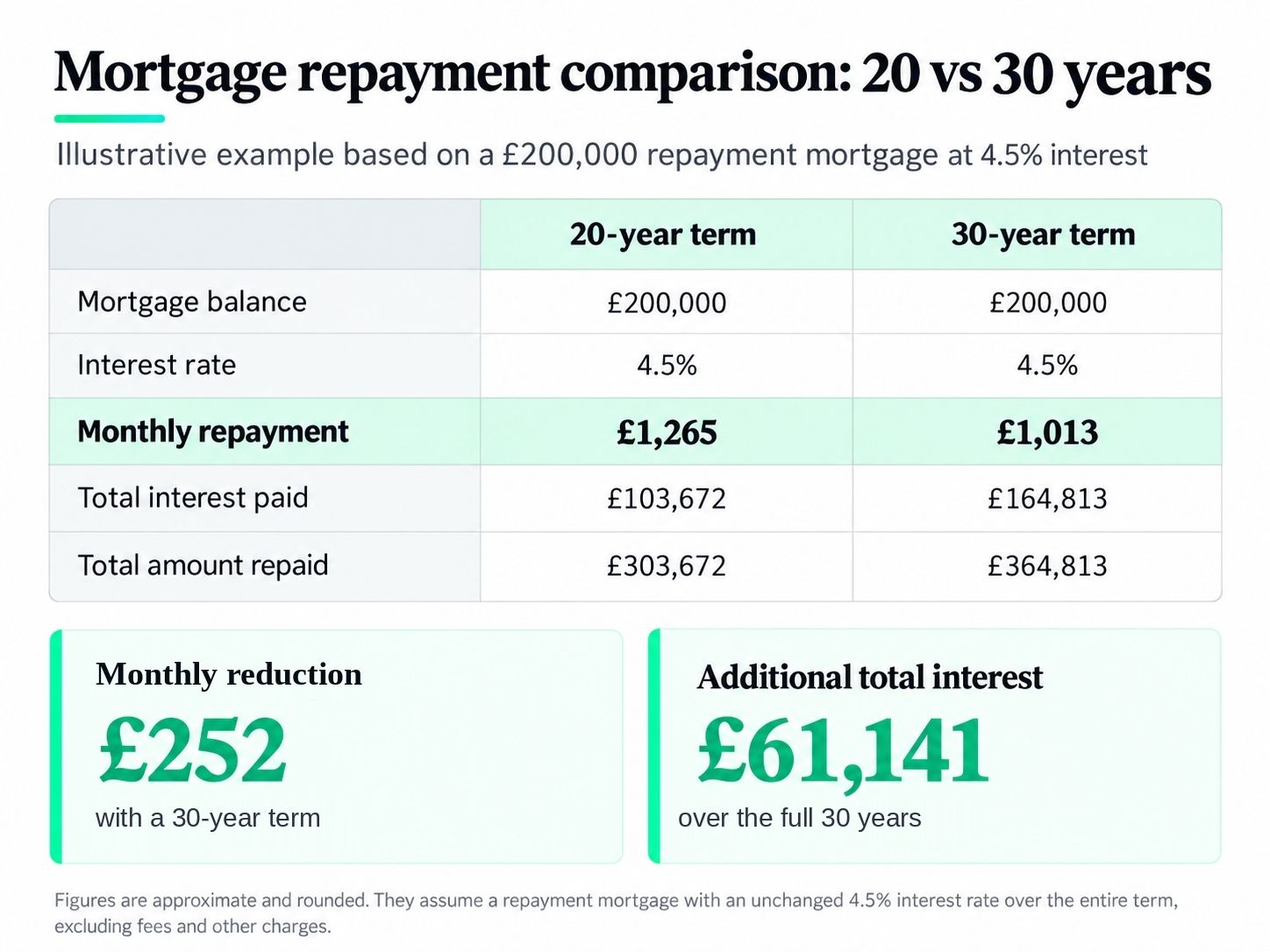
For example, consider a homeowner with a £200,000 repayment mortgage at 4.5%. Over 20 years, the monthly repayment would be approximately £1,265.
Extend the term to 30 years and the monthly payment falls to around £1,013. That’s a difference of roughly £250 per month.
Because of the global economy, many households are facing higher food, energy, childcare, and other living costs. A reduction of £250+ could make a meaningful difference to monthly disposable income. However, monthly savings tell only half the story…
An extended mortgage term can mean significantly more interest
The price of extending the mortgage term is that the debt remains outstanding for longer.
Let’s use that same £200,000 mortgage at 4.5% as an illustration. Repaying it over 20 years would cost about £104,000 in interest over the full term. Stretching the same mortgage over 30 years would increase the total interest to approximately £165,000.
That’s more than £60,000 of additional interest, assuming the rate remained unchanged throughout.
These figures are purely illustrative. That’s because, in reality, most borrowers will remortgage several times over the life of their mortgage. In most instances, the interest rate will change with every new deal.
But the principle remains the same: a lower monthly mortgage payment rarely means a cheaper mortgage overall.
When might a longer mortgage term make sense?
Extending your mortgage term will work better for some homeowners than others. Reducing your monthly commitment may matter more than minimising the total interest you eventually pay.
Imagine you took your current mortgage out years ago and are coming off a particularly low fixed rate. In today’s market, you may face a sizeable increase in your next monthly mortgage payment. If that increase puts unnecessary pressure on your household budget, extending the term could create breathing space.
It may also be appropriate where someone’s circumstances have temporarily changed due to:
- childcare costs,
- a reduction in household income, or
- another short-to-medium-term financial commitment.
The key is to view the mortgage as part of the wider household financial picture. View your position based on your living standards/expectations versus the amount of interest payable.
Paying more interest over the long term may be an acceptable trade-off if it leaves the monthly mortgage comfortably affordable today.
You don’t necessarily have to keep the longer term forever
Another perspective is to view any term extension as an interim measure for a short-term problem. You will remortgage at some point. So extending your mortgage term doesn’t have to be permanent. If your financial circumstances improve later, you may be able to reduce the term again when you remortgage.
Or you may be able to make mortgage overpayments in the meantime, depending on your mortgage terms. Many mortgages allow borrowers to overpay up to a certain level without an early repayment charge. The amount and frequency permitted vary by lender and mortgage, so please check your mortgage’s Ts & Cs for confirmation.
Overpaying can give borrowers some flexibility. For example, you may initially choose a 30-year term to keep your contractual monthly payment manageable. But you then voluntarily overpay when your finances allow.
Using a mortgage this way offers you a safety net. Yes, you can pay only the minimum monthly payment. But you retain the option to overpay, which can bring the interest and capital down much sooner than you think.
Sign up for our newsletter
Be the first to hear about mortgage deals and the latest news.
What about extending a mortgage into retirement?
Age is another important consideration when thinking of your mortgage term. Every lender has its own criteria for maximum mortgage terms and the age by which a mortgage must be repaid.
One such criterion is whether the mortgage would continue beyond your expected retirement age. The lender may then need to consider whether the payments would remain affordable once you retire.
The FCA imposes its own limits in that regard. It states that when a mortgage term extends into, or further into, retirement, the lender may have to run an affordability assessment.
These limitations don’t automatically rule out borrowing into retirement. But lenders will want to understand what income will be available then, and whether the mortgage remains sustainable.
Could you shorten the term again later?
When their current fixed-term deal is about to end, most homeowners remortgage. (If not, why not?! Check our Remortgage Rate Monitoring Service to put you in the best position before falling onto your lender’s SVR!)
So, yes: you can potentially reduce the term when you remortgage.
One advantage of reviewing your mortgage regularly is that the right mortgage term today may not be the right one five years from now.
Imagine that your disposable income increases. You pay off an unsecured loan. Childcare costs disappear. You get a promotion at work, or your partner starts work after a maternal/paternal break.
Or you may choose to use bonuses, savings or additional income to make overpayments that you left out of the affordability equation before. Given any of these changes, you may decide that you can comfortably increase your mortgage payments again.
At your next remortgage, you could then ask the question about reducing the outstanding mortgage term.
The important point is that extending the mortgage now doesn’t necessarily mean resigning yourself to paying it for the full extended period.
Should you extend your mortgage term?
Whether you could extend your mortgage and whether you should are two distinct questions. No single term works for every borrower.
A shorter mortgage term generally means higher monthly repayments, but less interest paid overall. A longer mortgage term does the opposite. It can make the monthly payment more manageable, but usually increases the overall cost of borrowing.
That’s why your decision shouldn’t be about choosing the lowest possible monthly repayment. You should also take into account:
- your income,
- your household expenditure,
- other financial commitments,
- your retirement plans, and
- how much flexibility you want in the years ahead.
When homeowners are approaching the end of a fixed rate, they often focus solely on the next rate they’ll pay. Reviewing the mortgage term alongside that rate could therefore be just as important when choosing your next mortgage deal.
At Freelancer Financials, our specialist mortgage advisers wear many hats. They can:
- review your circumstances,
- compare the options available, and
- help you understand how different mortgage terms could affect both your monthly repayments and the longer-term cost of your mortgage.
To see which options are available to you, contact our broking team now. Get your mortgage working for you for a change!
Share:
Ready to secure the mortgage you deserve?
Get in touch with our expert team today and take the first step toward a mortgage that truly reflects your earning potential. Contact us now and let’s make it happen.
Quick links

Contractor-friendly mortgage lenders

Contractor mortgage calculators

Your protection insurance options


